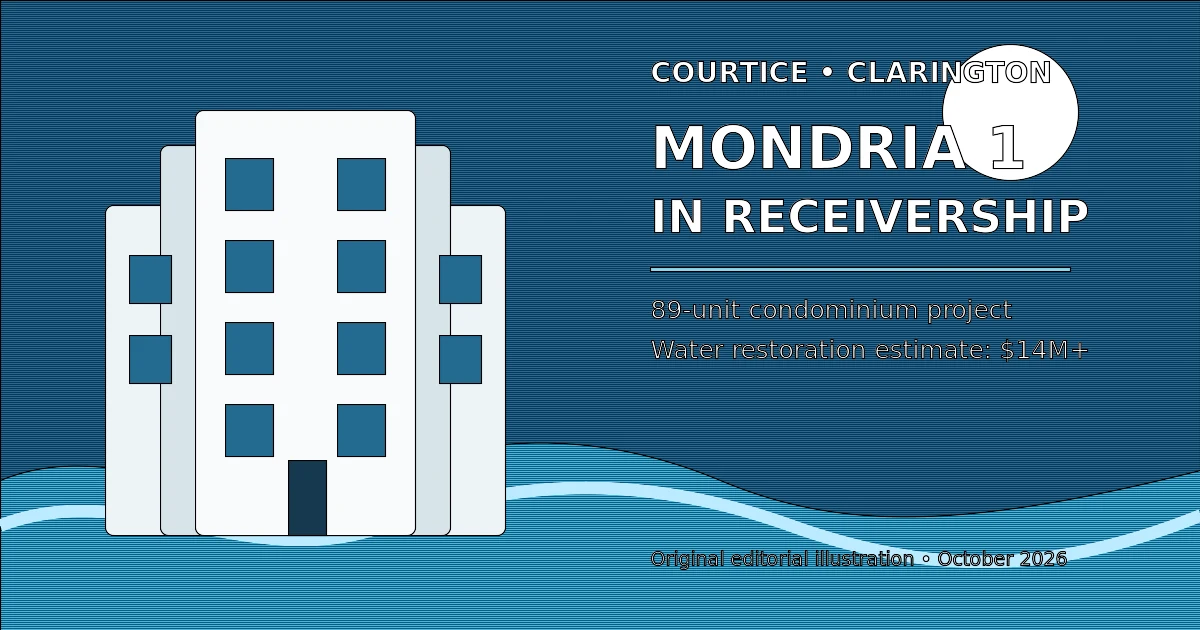
The Mondria 1 condominium receivership in Courtice is a stark example of how construction risk, lender risk and insurance timing can collide on one development.
The Ontario Superior Court appointed BDO Canada Limited as receiver and construction lien trustee for Monde Development Group Inc. on July 7, 2026. The unfinished six-storey project at 1607 King Street East contains 89 proposed units, with court information indicating that 76 purchase agreements were in place.
The project was under pressure before the flood damage
Public court information summarized by insolvency reporting says Monde had run out of money by late 2024. By April 2025, the project had recognized more than $8 million in cost overruns against an approximately $29 million budget, and construction slowed as trades went unpaid.
A second-ranking secured creditor later supported a construction restart. Then, in December 2025, a vandal opened a fire hose inside the building. The resulting damage affected units and common areas across several floors.
The lenders obtained a preliminary restoration estimate of more than $14 million and six to eight months of work. Monde submitted an insurance claim exceeding $15 million, but the court found there was no certainty that insurance proceeds would arrive soon enough to provide a completion solution.
Why a receiver was appointed
Meridian Credit Union, the first-ranking lender, said approximately $38.2 million was owing as of June 1, 2026, before further fees and interest. Together, Meridian and second-ranking secured creditor Ducimus Capital Inc. claimed approximately $55 million, with the exact amounts still subject to determination.
A court-appointed receiver is not the same as a residential power of sale. In a complex construction file, the receiver can take control of assets, preserve value, pursue insurance, evaluate financing and market the project under court supervision. BDO can now investigate a sale, investment or construction solution while addressing purchaser agreements and construction liens.
Four practical lessons from the Mondria file
- Near-completion estimates are not the same as funded completion. A project can appear physically advanced while still lacking the money required for remaining construction, deficiencies, carrying costs and unexpected repairs.
- Insurance proceeds have timing risk. The size of a claim does not mean the same amount is admitted, payable or immediately available.
- Pre-sales do not eliminate capital risk. Purchase agreements can support a project, but closings still depend on completion, occupancy and a workable financing structure.
- Court oversight can preserve options without guaranteeing an outcome. Receivership creates a structured process, but it does not promise that construction will resume on a particular date or that every agreement will close.
Anyone directly affected by a development receivership should monitor the receiver’s court materials and obtain independent legal advice. Purchasers should also keep financing approvals, deposits, notices and agreement deadlines organized, because their rights depend on the specific contract and court process.
Sources
- BDO Canada: Monde Development Group Inc. receivership
- Insolvency Insider: court and receivership summary
- STOREYS: Mondria water-damage report
- All About Durham: local news report
Last reviewed October 3, 2026. This article provides general information, not legal, mortgage or investment advice.